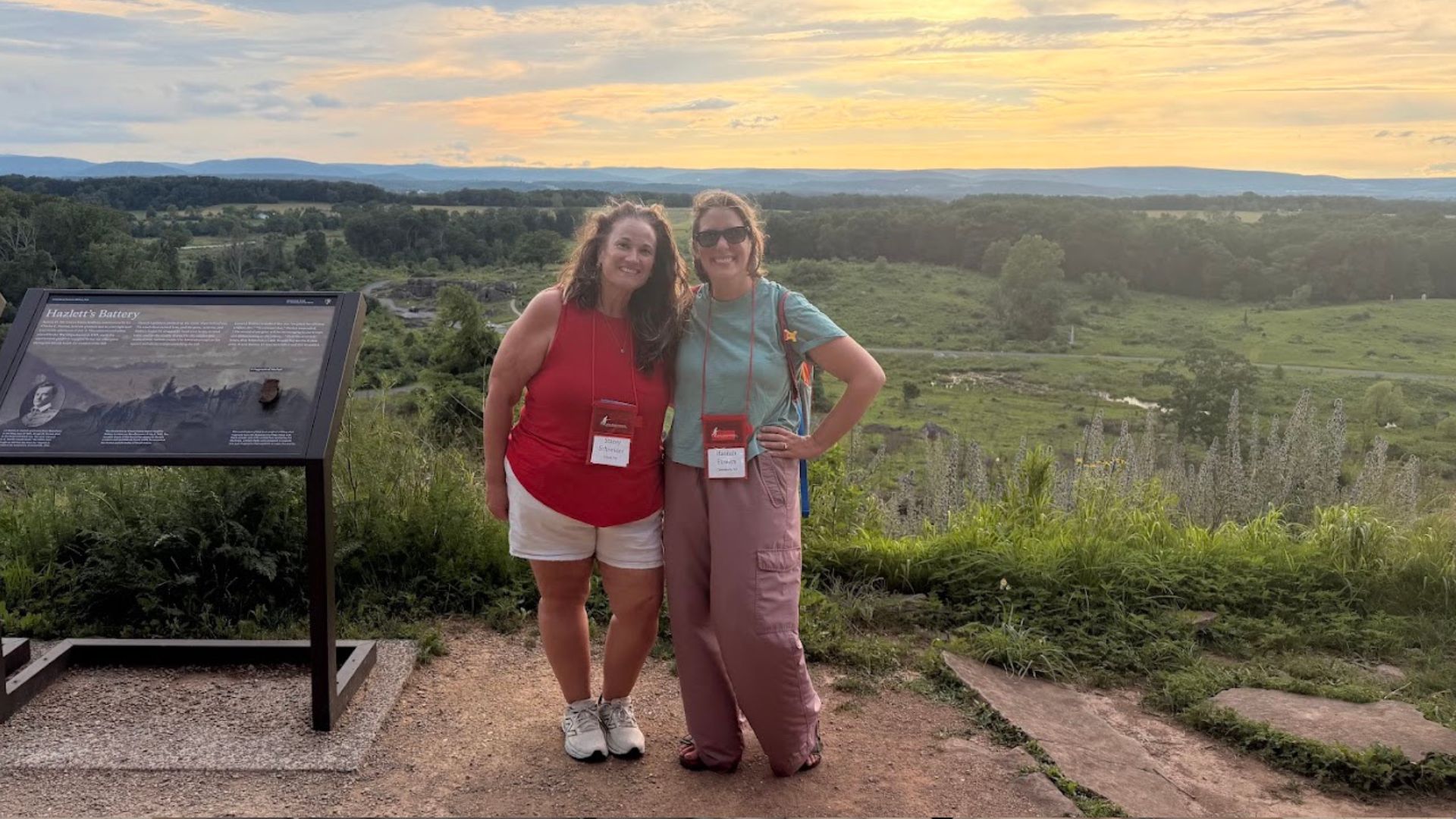
Students aren’t the only ones who take summer classes. Virginia Peninsula Community College’s Stacey Schneider, Hannah Powers and Pete Berquist all spent time furthering their education.
Schneider is chair of History, Geography and Political Science and an associate professor of history. Powers is a history instructor. They participated in the Civil War Institute Summer Conference. The six-day retreat and learning experience in mid-June took place at Pennsylvania’s Gettysburg College, exposing participants to seminars, conferences, discussions, field trips and interactive battlefield experiences.
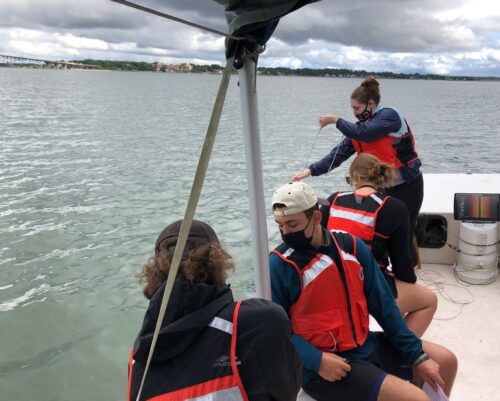
A week beforehand, Berquist, chair of the geology department and an assistant professor, was sailing the Pacific Ocean aboard a research vessel named in honor of astronaut Sally Ride. It was part of the 2YC STEAMSEAS Faculty Expedition. (2YC stands for two-year college.)
History, close up
For Schneider, it was an eye-opening experience and came at a great time. She has taught Civil War history at the College for more than 10 years.
“Sometimes you can get into a little bit of a rut when it comes to that period of the Civil War,” she said of the Battle of Gettysburg.
Taking a closer look at that battle was important to her.
“Just learning new things and new developments in the field,” she said. “People always think history is always the same. Not true. Not true. We’re reevaluating and exploring.
“History changes over time. That’s what the study of history is.”
Powers said it helped her, as a historian, reframe her class lectures.
“Stacey and I might be able to give two or three days to the Civil War in some of our history classes, but it really gave me pause at how I approach it with my students,” she said.
The concentration on Civil War history provided a different type of experience for Schneider and Powers. What really added to it was who was on the trip. It wasn’t just educators, but history buffs of all ages were among the 250 conference attendees.
“It was just people very passionate about Civil War history, and very, very knowledgeable at the various battles of the Civil War history that we were looking at,” Powers said.
It provided Schneider and Powers the opportunity to engage with history outside a textbook or academia. They visited places where history took place and spoke with people who are extremely knowledgeable about the topic.
“The people leading the tours obviously knew very, very specific details about the battles and the movements and the groups that were there,” Powers said. “But the attendees were also incredibly zoned in on the information.”
That hit home for Schneider since many in attendance were older and retired.
“It made me think about our mission as a community college,” she said. “These are the embodiment of lifelong learners. And these people know more about some aspects of the Civil War than I ever will know. They are serious students of the Civil War.”
The group stayed in the dorms at Gettysburg College and had roommates. That brought to mind another group of students, those who are transferring to four-year institutions.
“It was a really good reminder, and a touchstone of what college life is like. We were eating in the dining halls and by the fifth or sixth day, we had had enough of dining hall food,” she said.
She also was assigned a roommate she didn’t know.
“It made me think about the challenges that a lot of our students are going to face,” she said. “It was a different experience.”
She called it an “incredible privilege” to attend and was grateful the Center for Teaching and Learning and the Academic Affairs office allowed her and Powers to attend. The experience will have long-lasting effects.
“You can’t help but be inspired and carry that into your teaching in the fall,” Schneider said.
One thing that caught Powers’ attention was a lecture on death photography. It was common in the 19th century for people to have pictures taken with their deceased loved ones, especially children.
“But the lecture placed it in context of 19th century, where he really talked about people then were much more comfortable with the idea of death,” Powers said.
She said it’s important for students to really think about the history and period they are studying.
“I think is a really important distinction that I had never considered,” she said.
‘Seas-ing’ an opportunity
Nearly 3,000 miles from Gettysburg, Berquist was on one of what he likes to call “extended learning trips.” The Community College Faculty expedition, funded by the National Science Foundation, ran June 6- 13. The trip went from Seward, Alaska, to Newport, Ore. He has been on excursions before, mostly accompanying students, but this one was different.
“This was an opportunity for professional development and training, and an opportunity to see if this is something that I want to do in the future, be a mentor or a faculty leader, not just be a participant,” he said, noting this trip was for faculty only.
As with Schneider and Powers, he, too, expects to bring what he learned into his classroom.
“It was really, really cool to be introduced to a new community of geoscience teachers,” he said.
The trip was not limited to geologists. Joining Berquist were anatomy and physiology instructors, a marine science faculty and an artist. That diversity enhanced the experience.
“We had opportunities to teach each other and to share some of our approaches in teaching science, and then also teaching specific content,” he said.
He came away from the trip with activities, exercises and concepts to introduce to his students, as well as a new professional network. He already heard from someone on the trip who is interested in a field-based oceanography class that could be held in Virginia next summer.
“Some of the other richness is coming up with new opportunities for students,” Berquist said. “It’s not just the content. It’s working with your professional communities to come up with new ideas and new opportunities for students.”
Working vacations
While these trips might seem like vacations, they are not. Schneider and Powers had 10-hour days and long bus trips. Berquist was gone for almost two weeks, working much of that time.
“It is nice to travel,” Berquist admitted. “But there is so much more. These aren’t fun, family trips.”
He said it’s intense to be with colleagues or students 24 hours a day for days on end.
“There’s a lot of logistics that go into things. It’s not for everyone. It’s hard work,” he said.