A college isn’t the first place one might think to obtain a CDL or motorcycle license, but Virginia Peninsula Community College is the place for many.
The College is making it more convenient for students in its Commercial Driver License program to go from the classroom to the cab. After years of discussion, the College and Ancora Training, the company that conducts the classroom and behind-the-wheel instruction, are moving the driving range portion of the class to the Hampton Campus.
“It was common sense to have everyone in one location,” said Bobby Perkins, the College’s director of Manufacturing, Skilled Trades and Transportation.
Rick Clary, the Virginia area manager for Ancora, said the company is excited about the move.
“This is just going to be a great thing all the way around,” he said.
The CDL program currently provides classroom training in the College’s Hampton III Building and leases an outside space in Newport News for hands-on learning. The gravel driving range near Fort Eustis also affords students time out on the road. The new driving range will be on campus Parking Lot 10, a paved lot near the Peninsula Workforce Development Center.
“The gravel lot was really tough on us because after a period of time, the turning created a lot of holes,” Clary said. “There’s one out there they call a lake because when it rains, it fills right up.”
The gravel on the range isn’t the usual crush-and-run type, either. It consists of bigger rocks, which damage the trucks, especially the tires. And it’s harder to put down straight lines for training on the gravel. Students also were at a disadvantage when they took their DMV tests because those are done on asphalt with smoother surfaces and straighter lines.
“We’re going to train them like they are going to be tested,” Clary said. “When we train on gravel, the trucks do react a little differently.”
He said some students complained when they failed because the lots were so different.
Clary also prefers the new lot because it is near the workforce center. If students have enrollment or financial aid questions, they don’t have to go far for the answers. Iti’s also across the street from the classroom.
Recruiters also benefit. Clary said he tries to provide recruiters a classroom atmosphere when they visit campus. It’s sometimes challenging to meet students in the classroom if they are coming from the driving range. That drive can take anywhere from 30 to 45 minutes, depending on traffic. The last thing Clary wants is recruiters waiting around on campus.
Perkins pointed out an added marketing opportunity as the CDL trucks will be wrapped with VPCC signage.
“We will have more of a presence on the campus,” he said. “We will be able to market our CDL programs from the road because we’ll have those on the trucks.”
Another benefit is the move keeps the students on campus.
“It makes the students feel like they’re more part of the college community,” he said.
With the range off campus, once the students were done there, they often didn’t return to campus.
“Now, they get an opportunity to be engaged with what’s happening on campus,” Perkins said. “If they want to participate in college events or buy food from the food truck, they’re more closely connected to receive the benefits of being directly on campus with other students.”
The affected lot will be repaved, with new lines drawn to designate parking for the trucks. Some parking spots will be lost, but Perkins said, “the impact will be minimal.”
“We did consider that when we were having conversations,” he said, adding it’s a little-used lot. “We felt it would be better utilized.”
He said the move comes down to convenience.
“It makes sense to have everything right here, if possible,” Perkins said.
Added Clary: “It’s just going to be a great benefit to the students.”
Clary also hopes the new location allows the site to become a third-party testing location. If so, Ancora can have students perform their DMV tests on campus instead of at the DMV.
Motorcycle class update:
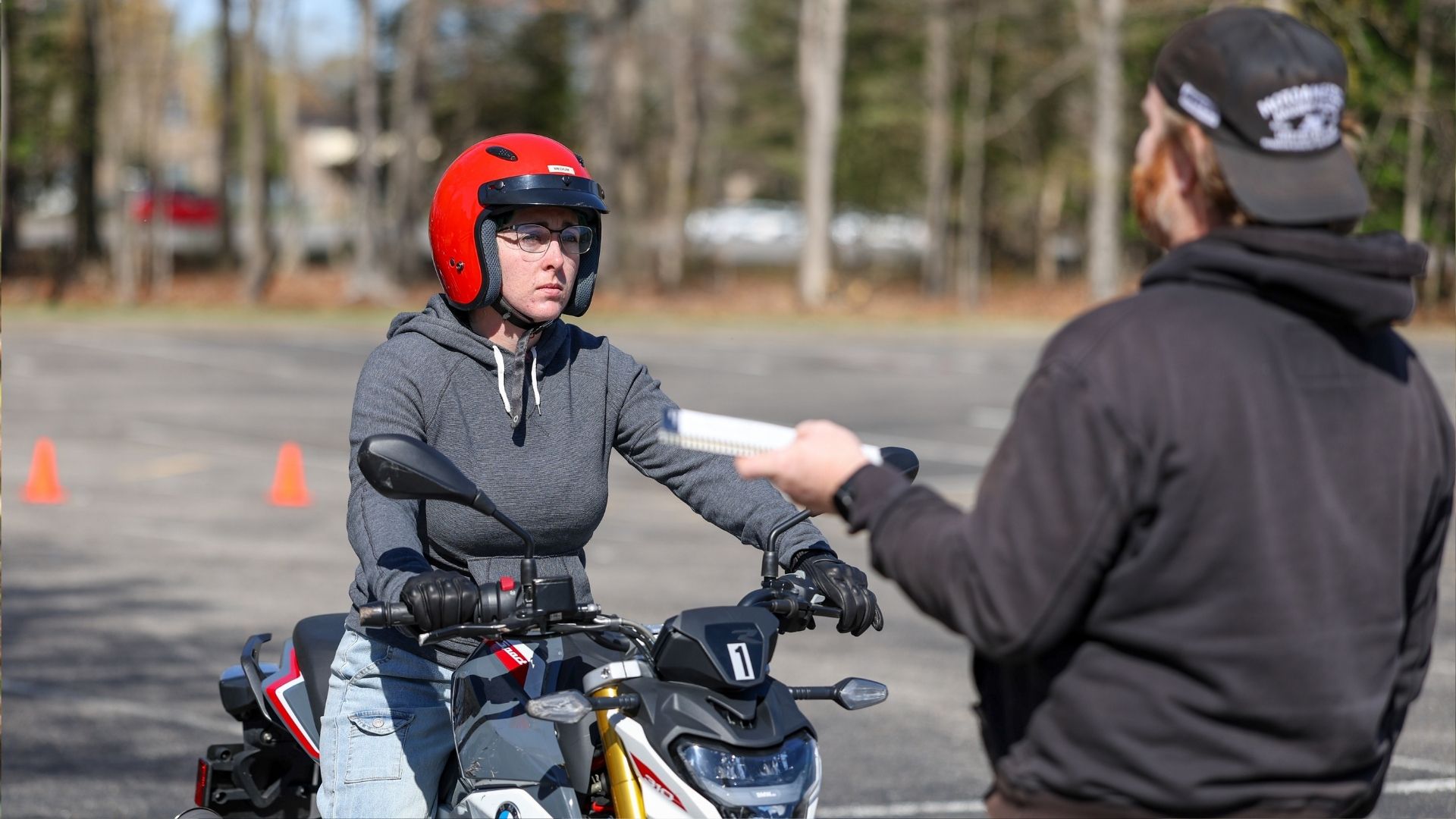
Unlike the CDL program, the motorcycle safety course has been exclusively on campus for more than 20 years.
Jennifer Freeman, who has been a rider coach since 2018, joined VPCC in that capacity in 2024 before being promoted to Lead Instructor for Program Management (site coordinator) in July 2025.
She said there’s no better place to learn the craft riding a motorcycle than at VPCC.
“I’ve seen many ranges,” she said. “I love this range.”
For training, she utilizes the parking lot behind the Peninsula Workforce Development Center and the lot adjacent to Templin Hall. She has the only full-size range and the only certified rider skills lab range in the area.
The College offers three options, starting with a one-day $75 introduction class (Pre-BRC). Freeman said it’s for those who aren’t too sure about riding a motorcycle but want to check it out before investing more time or money.
The Basic Rider Course (BRC) is a two-day class that costs $245, with motorcycles provided. The third option is the Basic Rider Course/Advance (BRC2), which is a one-day class that costs $125. It is for experienced riders who ideally would ride their own motorcycles.
Upon completion of the $125 or the $245 class and a skills evaluation, students will be fully legal to ride a motorcycle and don’t have to take a test at the DMV. Freeman also offers a retest at no cost for qualified riders who don’t pass the initial skills evaluation.
Freeman said classes through the College are much less expensive than other companies, and all are taught by nationally certified instructors with a vast array of experience.
The BRC is held almost every weekend, and the Pre-BRC and BRC2 classes are held once a month. Classes are limited to 10 students, and there are two coaches for each class.