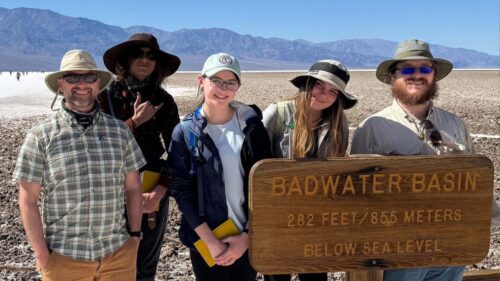
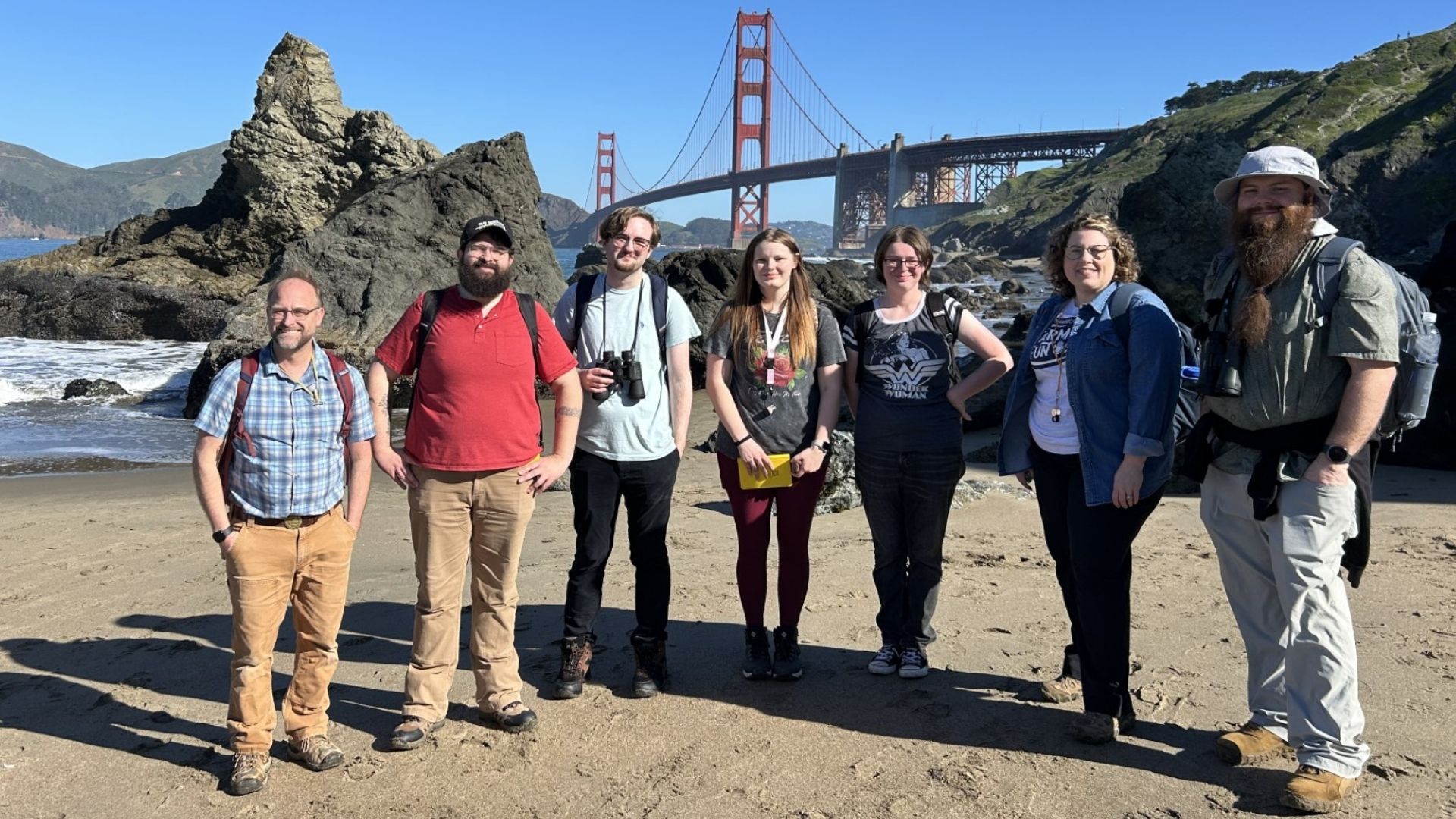
On a recent weeklong field trip to Northern California, Joey King had the opportunity to learn more about geology, his chosen field of study at Virginia Peninsula Community College. He also had the opportunity to learn more about himself, which he thought was just as important.
In his VPCC classes, King isn’t afraid to share his thoughts. However, the most challenging part of the trip for King was that willingness to be wrong in front of people he doesn’t know.
“I don’t really care if I’m wrong in class, but when you’re out in the field …,” he said before pausing. “You get over it at some point.”
That attitude led to the best thing about the trip he took with a group of 20 students and instructors from VPCC and Piedmont Virginia Community College: examining rock formations with other students and creating a backstory to explain the formations. Once King and his classmates felt confident with their story, they would share their ideas with the instructors and other students, leading to more discussions and more learning.
King grew up in Tennessee and is in his second year at VPCC. He’s hoping to transfer to William & Mary and continue studying geology. This was his first trip to California. He was nervous at the beginning because he was traveling with a group of people he didn’t know, a situation that forced him to learn even more about himself.
“The first day, I would say I was pretty apprehensive just to see what was going on and what it was going to be like,” he said. “Once it got going, it was such a cool experience.”
The VPCC contingent consisted of five students – King, Wayne Riddle, Bella Woodfin, Erika Ward and Kyle Cork – and geology instructors Pete Berquist and Lynsey LeMay. Arranging the trip was Callan Bentley, an associate professor of geology from Piedmont. The trip was part of a four-credit course through PVCC. Students have met synchronously via Zoom on Tuesdays throughout the semester.
Pairing classroom and hands-on experiences did more than provide King with knowledge.
“I’m exceedingly more confident in being able to tell you the conditions where (a) rock was formed, what that rock was probably made of,” he said.
Whenever he’s out walking around, he’s always noticing the rocks, trying to identify them.
“It’s nice to be able to have the experience … and know that you have practiced these skills and can put these skills to applicable uses,” he said.
The group flew into San Francisco and stayed in the Marina District the first few days, visiting area beaches, Angel Island and Mount Diablo state parks. They studied the tectonic history of Northern California. Later in the trip, the group stayed at the Point Reyes National Seashore.
LeMay took a similar trip as a student but not as an instructor. For her, the best part was watching the students as they saw firsthand the things they had talked about in the classroom.
“Here in Coastal Virginia, we talk a lot about igneous and metamorphic rocks and deformation processes,” she said. “But if we go outside our door, we don’t see those.”
Instead, they study pictures, graphs and diagrams.
“To be able to lay your eyes on these outcrops and to start making sense of these global-scale processes, just to see all the wheels turning and all these ideas ignite, that was the best part,” she said.
LeMay, who noted it’s also valuable for faculty, said the experience will help students in more than just academic ways.
“This is the type of stuff they could write on applications, of getting real-world field experiences and networking with other scientists,” she said, adding a couple of scientists joined them on part of the trip to help them understand aspects of the topography.
Creating those opportunities for students can have a lasting and meaningful impact on immediate futures and potentially trajectories, LeMay said.
King agreed.
“There’s only so much we can see here,” he said. “It was really cool to go see those rock formations with people who are so knowledgeable.”
LeMay pointed out one other benefit: the camaraderie that develops on these trips, whether long or short.
“I recognize my bias in this, but getting students outside to see things, and with each other, the wheels start turning, you become fast friends with those around you, and it changes the whole educational atmosphere,” she said.
As King learned, that education extends beyond the classroom topics to personal growth.