

EMERGENCY:
From Your Cell Phone Dial or Text 9-1-1 (Local Police, Fire, and EMS)
SUICIDE CRISIS HOTLINE:
Dial or Text 9-8-8
Administrative Office
Hampton Campus
Templin Hall: Room 862
99 Thomas Nelson Drive
Hampton, VA 23666
HT Precinct
Historic Triangle Campus
Academic Bld.: Room 111
4601 Opportunity Way
Williamsburg, VA 23188

Attention: For your safety and security, Virginia Peninsula Community College (the College) uses video surveillance at facilities (indoor and outdoor) owned and/or controlled by the College.
About the Department of Police, Safety, and Security
- The Virginia Peninsula Community College Department of Police, Safety, and Security deploys a combination of police, safety, security, and communications officers who are committed to establishing and maintaining an environment that facilitates a culture of safety, security, risk and hazard mitigation, and emergency preparedness which supports educational delivery, student learning, creative collaboration, and active engagement opportunities for students, faculty, staff and visitors of our College.
- All Virginia Peninsula Community College police and security officers are fully certified by Virginia’s Department of Criminal Justice Services. Our police officers are sworn to serve, protect, and preserve the public peace, protect life and property, and uphold Virginia’s laws, and have the same authority and responsibilities as all other law enforcement officers in the Commonwealth of Virginia. Our security and safety officers are charged with enforcing the College’s regulations. Our Communications Officers staff the department’s communications center and work to facilitate the flow of information between callers in need of information and/or services and responding department members.
- All department members are responsible for the provision of services that identify and mitigate threats, hazards, and risks through professional development, exercises, planning, response, and the employment of best practices in campus/community policing, crime prevention, safety and security practices, routine visibility, campus and community collaboration. We are dedicated to your well-being.
Department of Police, Safety, and Security Mission Statement
- The mission of the Virginia Peninsula Community College Department of Police, Safety and Security is to promote a safe and secure environment and community, deter crime and mitigate injury, and encourage positive and trusting relationships while effectively and efficiently serving students, staff, faculty, and the community.
Department of Police, Safety, and Security Outcomes
- Department police officers, safety officers, security officers, and communications officers work diligently every day to:
- Promote a safe and secure campus environment and community.
- Deter crime and mitigating injury.
- Encourage positive and trusting relationships.
- Serve the students, staff, faculty, and community.
- Ensure efficient and effective operations.
Our Department Emblems
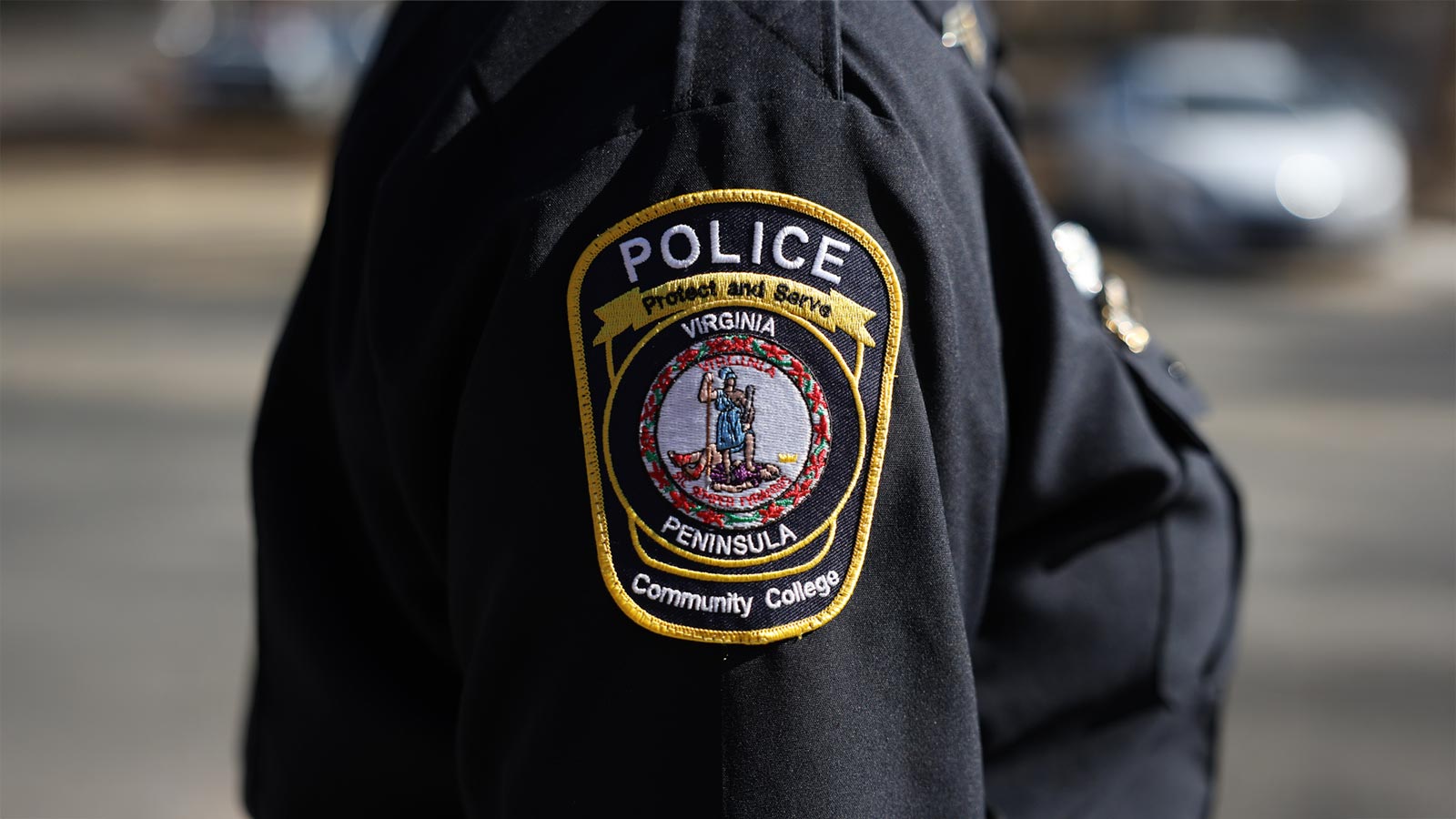
- The official emblem of the Department of Police, Safety, and Security was designed by one of the department’s police officers in 2022. The redesign of the department’s emblem coincided with the renaming of the college. The original design was initially only used as the “Police” emblem. The officer’s design was later adapted across all of the service areas provided by the department and is proudly displayed by department members in the performance of their duties based upon their assignment within the department.




Annual Security Report and Crime Statistics
- Colleges and universities that receive funding from federal financial aid programs are required to disclose information about crime on and around their campuses. Virginia Peninsula Community College discloses crime statistics and publishes an Annual Security Report, as well as provides additional information required by the Jeanne Clery Act. To review this information visit the College’s Jeanne Clery Act Information and Statistics webpage.
Department of Police, Safety, and Security Mission Statement
- The mission of the Virginia Peninsula Community College Department of Police, Safety and Security is to promote a safe and secure environment and community, deter crime and mitigate injury, and encourage positive and trusting relationships while effectively and efficiently serving students, staff, faculty, and the community.
Department of Police, Safety, and Security Outcomes
- Promote a safe and secure campus environment and community.
- Deter crime and mitigating injury.
- Encourage positive and trusting relationships.
- Serve the students, staff, faculty, and community.
- Ensure efficient and effective operations.
Our Department Emblems
- The official emblem of the Department of Police, Safety, and Security was designed by one of the department’s police officers in 2022. The redesign of the department’s emblem coincided with the renaming of the college. The original design was initially only used as the “Police” emblem. The officer’s design was later adapted across all of the service areas provided by the department and is proudly displayed by department members in the performance of their duties based upon their assignment within the department.
If You See Something, Say Something – REPORT IT!
- Emergency or Crime in Progress – Dial or Text 911 – When Safe to do so!
- Non-Life-Threatening Behavioral Health Crisis – Dial or Text 988.
- Virginia Peninsula Community College is committed to providing an environment that is free from harassment and discrimination, The College is committed to providing an educational environment free of all forms of sex discrimination, sexual harassment, and sexual misconduct, discrimination, as well as prevents and deters criminal and unlawful behavior, based on any status protected by law. As required by Title IX and the Jeanne Clery Act, the College requires all employees, and strongly encourages all students, guests, and/or contractors to report incidents and/or crimes immediately. Non-emergency reports can be submitted by using the REPORT IT! webpage.
Stay Connected: Receive Timely Warnings & Emergency Notifications
- Virginia Peninsula Community College provides Timely Warnings and Emergency Notifications via the VPCC Gator Ready App and VPCC Gator Alert Emergency Notification System. Learn more, download the app, and register for emergency notifications by visiting the VPCC Gator Ready and Gator Alert webpage.
Community Policing Act
Effective July 1, 2021, the Virginia General Assembly enacted the Community Policing Act, which is found in the Code of Virginia §15.2-1722.1, and defined below:
§ 15.2-1722.1. Prohibited practices; collection of data.
- No law-enforcement officer shall engage in bias-based profiling as defined in § 52-30.1 in the performance of his official duties.
- The police force of every locality shall collect data pertaining to (i) all investigatory motor vehicle stops, (ii) all stop-and-frisks of a person based on reasonable suspicion, and (iii) all other investigatory detentions that do not result in an arrest or the issuance of a summons pursuant to § 52-30.2 and report such data to the Department of State Police for inclusion in the Community Policing Reporting Database established pursuant to § 52-30.3. The chief of police of the locality shall be responsible for forwarding the data to the Superintendent of State Police.
- The chief of police of the locality shall post the data that has been forwarded for inclusion in the Community Policing Reporting Database on a website that is maintained by the chief of police or on any other website on which the chief of police generally posts information and that is available to the public or that clearly describes how the public may access such data.
§ 52-30.1. Definition – Virginia Law
- For purposes of this chapter, unless the context requires a different meaning, “bias-based profiling” means actions of a law-enforcement officer that are based solely on the real or perceived race, ethnicity, age, gender, or any combination thereof, or other noncriminal characteristics of an individual, except when such characteristics are used in combination with other identifying factors in seeking to apprehend a suspect who matches a specific description.
§ 52-30.2. Prohibited practices; collection of data.
- No State Police officer shall engage in bias-based profiling in the performance of his official duties.
- State Police officers shall collect data pertaining to (i) all investigatory motor vehicle stops, (ii) all stop-and-frisks of a person based on reasonable suspicion, and (iii) all other investigatory detentions that do not result in an arrest or the issuance of a summons to be reported into the Community Policing Reporting Database. State Police officers shall submit the data to their commanding officers, who shall forward it to the Superintendent of State Police.
- Each time a law-enforcement officer or State Police officer stops a driver of a motor vehicle, stops and frisks a person based on reasonable suspicion, or temporarily detains a person during any other investigatory stop, such officer shall collect the following data based on the officer’s observation or information provided to the officer by the driver: (i) the race, ethnicity, age, gender of the person stopped, and whether the person stopped spoke English; (ii) the reason for the stop; (iii) the location of the stop; (iv) whether a warning, written citation, or summons was issued or whether any person was arrested; (v) if a warning, written citation, or summons was issued or an arrest was made, the warning provided, violation charged, or crime charged; (vi) whether the vehicle or any person was searched; and (vii) whether the law-enforcement officer or State Police officer used physical force against any person and whether any person used physical force against any officers.
- Each state and local law-enforcement agency shall collect the number of complaints the agency receives alleging the use of excessive force.
§ 52-30.2. Prohibited practices; collection of data.
- No State Police officer shall engage in bias-based profiling in the performance of his official duties.
- State Police officers shall collect data pertaining to (i) all investigatory motor vehicle stops, (ii) all stop-and-frisks of a person based on reasonable suspicion, and (iii) all other investigatory detentions that do not result in an arrest or the issuance of a summons to be reported into the Community Policing Reporting Database. State Police officers shall submit the data to their commanding officers, who shall forward it to the Superintendent of State Police.
- Each time a law-enforcement officer or State Police officer stops a driver of a motor vehicle, stops and frisks a person based on reasonable suspicion, or temporarily detains a person during any other investigatory stop, such officer shall collect the following data based on the officer’s observation or information provided to the officer by the driver: (i) the race, ethnicity, age, gender of the person stopped, and whether the person stopped spoke English; (ii) the reason for the stop; (iii) the location of the stop; (iv) whether a warning, written citation, or summons was issued or whether any person was arrested; (v) if a warning, written citation, or summons was issued or an arrest was made, the warning provided, violation charged, or crime charged; (vi) whether the vehicle or any person was searched; and (vii) whether the law-enforcement officer or State Police officer used physical force against any person and whether any person used physical force against any officers.
- Each state and local law-enforcement agency shall collect the number of complaints the agency receives alleging the use of excessive force.
Crime in Virginia
- The most updated portion of the Uniform Crime Reporting Section of the Department of the State Police entitled “Crime in Virginia” must be made available to any interested party upon request as it pertains to institutions of higher education.
- This document can be accessed by either requesting a paper copy via the Department of Police, Safety, and Security email (police-safety-security@vpcc.edu) or by physically picking up a copy at the Department’s Administrative Office, located in Suite 4124 of the Hampton IV Building, 521 Butler Farm Road, Hampton, Virginia 23666.
- You can also access directly by clicking here.
Drug Free Schools and Communities Act
In compliance with the Federal Drug Free Schools and Communities Act of 1989, as amended, Virginia Peninsula Community College provides the following information related to alcohol and drugs on campus, specific to standards of conduct, legal and disciplinary sanctions, and penalties for violations, health risks, and available prevention and assistance programs.
The U.S. Department of Education’s Drug Free Schools and Communities Act requires that as a condition of receiving any form of financial assistance under any Federal program, an institution of higher education must adopt and implement Drug and Alcohol Abuse Prevention Program(s) [DAAPP] to prevent the unlawful possession, use, manufacture or distribution of illicit drugs and alcohol by students, employees, and/or guests. These programs, provided upon request, include but are not limited to, Alcohol Awareness, Drug Awareness, and informational materials available from the VPCC Department of Police, Safety, and Security:
Hampton Campus – Templin Hall – Room 862
99 Thomas Nelson Drive
Hampton, Virginia 23666
Historic Triangle Campus – Room 111
4601 Opportunity Way
Williamsburg, Virginia 23188
Additionally, additional programs are available and provided by other departments on campus throughout the academic year.
Definitions
- CONTROLLED SUBSTANCE: A drug or substance found in Section 54.1-3401 and Schedules I through VI of Sections 54.1-3446 through 3456 of the Code of Virginia, as amended, and Section 202 of the Federal Controlled Substances Act (21 USC. 812).
- ALCOHOL: Any product as defined in “The Alcoholic Beverage Control Act,” Section 4-2 of the Code of Virginia, as amended.
- CRIMINAL DRUG STATUTE: A criminal statute prohibiting the unlawful manufacture, distribution, dispensation, use, or possession of any controlled substance.
- DRUG: Any controlled substance or prescribed or non-prescribed medication, taken into the body, other than alcohol, which may impair one’s mental faculties and/or physical performance.
The College prohibits the unlawful possession, use, manufacture, sale or distribution of illicit drugs and alcohol by employees, students, contracted agents, volunteers and guests on College property (owned or leased) or at any College sponsored activity. Additionally, alcohol related or disorderly behavior on College property is prohibited. Convictions for violations of these laws could result in fines, loss of driver’s license and imprisonment as determined by the applicable state or federal law. All residence halls on the campus are considered to be alcohol free. Alcohol is prohibited in every residential room, study area, computer lab, lounge or any other room in the halls regardless of whether the student or guest is of the age of majority (21 years of age).
Effective July 1, 2021, the code of Virginia 18.2-250.1, pertaining to possession of marijuana, has been repealed. The new law(s) regarding the possession of marijuana are defined as follows:
§ 4.1-1100; Possession of marijuana by persons 21 years of age or older.
- Except as otherwise provided in this subtitle and notwithstanding any other provision of law, a person 21 years of age or older may lawfully possess on his person or in any public place not more than one ounce of marijuana or an equivalent amount of marijuana product as determined by regulation promulgated by the Board.
- Any person who possesses on his person or in any public place marijuana or marijuana products in excess of the amounts set forth in subsection A is subject to a civil penalty of no more than $25. The penalty for any violations of this section by an adult shall be pre-payable according to the procedures in § 16.1-69.40:2.
- With the exception of possession by a person in his residence or possession by a licensee in the course of his duties related to such licensee’s marijuana establishment, any person who possesses on his person or in any public place (i) more than four ounces but not more than one pound of marijuana or an equivalent amount of marijuana product as determined by regulation promulgated by the Board is guilty of a Class 3 misdemeanor and, for a second or subsequent offense, a Class 2 misdemeanor and (ii) more than one pound of marijuana or an equivalent amount of marijuana product as determined by regulation promulgated by the Board is guilty of a felony punishable by a term of imprisonment of not less than one year nor more than 10 years and a fine of not more than $250,000, or both.
§ 4.1-1100; Possession of marijuana by persons under 21 years of age.
- No person younger than 21 years of age shall consume or possess, or attempt to consume or possess, any marijuana or marijuana products, except by any federal, state, or local law-enforcement officer or his agent when possession of marijuana or marijuana products is necessary in the performance of his duties. Such persons may be prosecuted either in the county or city in which the marijuana or marijuana products were possessed or consumed or in the county or city in which the person exhibits evidence of physical indicia of consumption of marijuana or marijuana products.
- Any person 18 years of age or older who violates subsection A is subject to a civil penalty of no more than $25 and shall be ordered to enter a substance abuse treatment or education program or both, if available, that in the opinion of the court best suits the needs of the accused.
§ 4.1-1107; Consuming marijuana in a moving vehicle.
- It is unlawful for any person to use or consume marijuana or marijuana products while driving a motor vehicle upon a public highway of the Commonwealth or while being a passenger in a motor vehicle being driven upon a public highway of the Commonwealth. Any person who violates this section is guilty of a Class 4 misdemeanor.
- For the purposes of this section:
- “Open container” means any vessel containing marijuana or marijuana products, except the originally sealed manufacturer’s container.
- “Passenger area” means the area designed to seat the driver of any motor vehicle, any area within the reach of the driver, including an unlocked glove compartment, and the area designed to seat passengers. “Passenger area” does not include the trunk of any passenger vehicle; the area behind the last upright seat of a passenger van, station wagon, hatchback, sport utility vehicle or any similar vehicle; the living quarters of a motor home; or the passenger area of a motor vehicle designed, maintained, or used primarily for the transportation of persons for compensation, including a bus, taxi, or limousine, while engaged in the transportation of such persons.
§ 4.1-1108; Consuming or offering marijuana in a public place.
- No person shall consume marijuana or a marijuana product or offer marijuana or a marijuana product to another, whether accepted or not, at or in any public place.
- Any person who violates this section is subject to a civil penalty of no more than $25 for a first offense. A person who is convicted under this section of a second offense is subject to a $25 civil penalty and shall be ordered to enter a substance abuse treatment or education program or both, if available, that in the opinion of the court best suits the needs of the accused. A person convicted under this section of a third or subsequent offense is guilty of a Class 4 misdemeanor.
It should be understood that, although the laws pertaining to marijuana have changed in the Commonwealth of Virginia, marijuana is still not allowed to be possessed on any campus property and is considered a policy violation. This is due to the requirements of the federal law under the Drug Free Schools and Communities Act.
Tobacco:
Virginia Peninsula Community College (VPCC) fully complies with the tobacco regulations of the Commonwealth of Virginia. All state laws apply to VPCC employees, students, and guests.
Effective July 1, 2019, the code of Virginia, § 18.2-371.2, prohibits the purchase or possession of tobacco products, nicotine vapor products, and alternative nicotine products by a person under 21 years of age or sale of tobacco products, nicotine vapor products, and alternative nicotine products to persons under 21 years of age. Additionally, smoking and/or vaping inside or within 25 feet of building entrances or windows is prohibited.
College sanctions for students who are found responsible for violations of these laws and policies are described in the Student Handbook and include, but are not limited to, verbal warning, letter of censure, loss of privilege/privilege restrictions, completion of educational experiences, fee/fines, deferred sanction, disciplinary probation, disciplinary suspension, or disciplinary dismissal.
Any employee who is found to be in violation of these laws and policies may be subject to criminal prosecution, disciplinary action, including discharge, and/or referral to an assistance or rehabilitation program at the discretion of Human Resources and applicable committees responsible for the enforcement of such conduct.
Many physical and psychological health risks are associated with the abuse of alcohol and other substances, including difficulty with attention and learning, physical and psychological dependence, damage to brain, liver and heart, unwanted sexual activity and accidents due to impaired judgment and coordination.
Anyone who may need assistance with a drug or alcohol problem is encouraged to contact 988 for community resources or contact the VPCC Department of Police, Safety, and Security at (757) 825-2732 for information on how to access resources. Assistance for employees is available for counseling and referral for drugs and alcohol as outlined by Human Resources.
More information regarding the health risks associated with the use of illicit drugs and the abuse of alcohol can be reviewed on the following websites:
Department of Justice: Drugs and Substance Use
National Institute on Alcohol Abuse and Alcoholism: Alcohols Effects on Health
U.S. Centers for Disease Control and Prevention: Alcohol Use
National Institute on Alcohol Abuse and Alcoholism: College Drinking – Changing the Culture
Law Enforcement Code of Ethics
- As a law enforcement officer, my fundamental duty is to serve the community; to safeguard lives and property; to protect the innocent against deception, the weak against oppression or intimidation, and the peaceful against abuse or disorder; and to respect the constitution rights of all liberty, equality, and justice.
- I will keep my private life unsullied as an example to all and will behave in a manner that does not bring discredit to me or to my agency.
- I will maintain courageous calm in the face of danger, scorn, or ridicule; develop self-restraint; and be constantly mindful of the welfare of others. Honest in thought and deed both in my personal and official life, I will be exemplary in obeying the laws and the regulations of my department. Whatever I see or hear of a confidential nature or that is confided to me in my official capacity will be kept ever secret unless revelations are necessary in the performance of my duty.
- I will never act officiously or permit personal feelings, prejudices, political beliefs, aspirations, animosities, or friendships to influence my decisions. With no compromise for crime and with relentless prosecution of criminals, I will enforce the law courteously and appropriately without fear or favor, malice or ill will, never employing unnecessary force or abuse and never accepting gratuities.
- I recognize the badge of my office as a symbol of public faith, and I accept it as a public trust to be held as long as I am true to the ethics of police service. I will never engage in acts of corruption or bribery, nor will I condone such acts by other police officers. I will cooperate with all legally authorized agencies and their representatives in the pursuit of justice.
- I know that I alone am responsible for my own standard of professional performance and will take every reasonable opportunity to enhance and improve my level of knowledge and competence.
- I will constantly strive to achieve objectives and ideas, dedicating myself before God to my chosen profession…. law enforcement.
Tell Us How We Are Doing: Compliments, Concerns, Commendations, Complaints
- We Want to Hear from You: Please take a moment to share your feedback with our department. Use our feedback form to share your comments, compliments, concerns, commendations, or complaints regarding our services and/or personnel! DO NOT use this form to report incidents or crimes, this is not a link to the college’s reporting systems. Feedback submissions are NOT monitored 24/7.
Safety is Everyone’s Responsibility – Prepare to Take Action Now
- VPCC’s Take Action Guides provide preparedness and response information for a variety or potential situations, incidents, and/or emergencies, review VPCC’s Take Action Guides before you need to Take Action!
Timely Care Behavioral Health and Wellness Assistance for Students & Employees
- If you or someone you know is experiencing a behavioral health crisis or is suicidal, please dial or text 9-8-8 to reach the National Suicide and Crisis Lifeline. The National Suicide and Crisis Lifeline provides free and confidential support for people in distress, prevention and crisis resources for you or your loved ones, and best practices for professionals in the United States. Please know that this may elicit a response by local emergency services, behavioral health professionals, or members of the Department of Police, Safety, and Security.
- The Department of Police, Safety, and Security has officers who have completed Crisis Intervention Team (CIT) training.
- Virginia Peninsula Community College employees and students have FREE, 24/7 access to virtual care services with TimelyCare — the virtual health and well-being platform from TimelyCare, designed for college students. Students do not need insurance to access TimelyCare services. Download the app here.